
Self-Replicating Packages: What Shai-Hulud Means for Developer Credentials
September was the month the npm ecosystem’s worst-case scenarios stopped being theoretical.
On September 8, a maintainer of widely used packages, including chalk and debug, was phished through a convincing fake npm support domain. Attackers published malicious versions of 18 packages with a combined download count in the billions per week. The payload attempted to redirect cryptocurrency transactions in browsers. It was caught and removed within hours, but the reach was enormous.
A week later, something more dangerous appeared. Starting around September 15, researchers identified a self-replicating worm, quickly named Shai-Hulud, spreading through npm packages. Within days it had compromised hundreds of packages. On September 23, CISA issued an alert recommending that organizations review dependencies and rotate developer credentials.
How the worm spread
The worm’s design was simple, which is what made it effective.
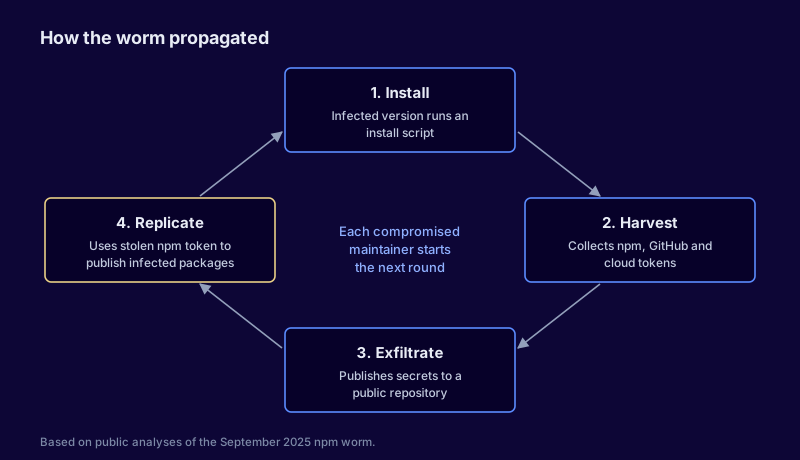
Figure 1. Shai-Hulud’s propagation cycle, as described in public analyses. Each compromised maintainer became the starting point for the next round.
- Install. A developer or build system installed an infected package version. A script that ran automatically during installation executed the payload.
- Harvest. The payload searched the environment for secrets: npm tokens, GitHub tokens, and cloud provider credentials. It reportedly used a legitimate open-source secret scanning tool to find more.
- Exfiltrate. Stolen secrets were published to newly created public GitHub repositories under the victim’s account, and the payload added a GitHub Actions workflow to push secrets from the victim’s repositories.
- Replicate. Using any npm token it found, the worm published new infected versions of every package that token could publish. Each new version started the cycle again for everyone who installed it.
The worm needed no command-and-control infrastructure to spread. The ecosystem’s own trust relationships did the work.
Why developer environments are such good targets
The incident exposed three conditions that are common in most organizations’ development practice:
Long-lived, broadly scoped tokens on developer machines. npm publish tokens, GitHub personal access tokens and cloud credentials often sit in configuration files or environment variables, valid indefinitely and usable for far more than the task at hand.
Install scripts that run by default. Package managers run lifecycle scripts automatically, so installing a dependency means running code from its author, with the developer’s privileges.
Fast adoption of new versions. Version ranges in manifests and automated update tooling mean that a new malicious release can reach many environments within hours.
None of these is a mistake in isolation. Together they turn one phished maintainer into an ecosystem-wide incident.
Controls that break the chain
The useful question is which link in the cycle each control breaks.
| Link | Control | Notes |
|---|---|---|
| Install | Pin dependencies with lockfiles, and add a delay before adopting new versions | A short cooling-off period would have avoided most exposure; malicious versions were usually removed within hours or days |
| Install | Disable install scripts by default, and allow them per package | Breaks many packages at first; work through the exceptions deliberately |
| Harvest | Remove long-lived tokens from developer machines and CI environments | Use short-lived credentials issued per task, and keep cloud credentials out of developer environments |
| Harvest | Run builds in isolated, ephemeral environments with only the secrets they need | Limits what a payload can find |
| Exfiltrate | Monitor for new public repositories and unexpected workflow files in your organization’s accounts | The worm created both; they’re detectable |
| Replicate | Require phishing-resistant MFA for package publishing, and move to trusted publishing from CI where the registry supports it | A stolen token alone shouldn’t be enough to publish |
Responding if you were exposed
Organizations that installed affected versions should:
- identify every machine and pipeline that installed an affected version during the exposure window, using lockfile history and build logs
- rotate npm, GitHub and cloud credentials that were present on those systems, prioritizing the most privileged
- review GitHub organizations for repositories and workflows created during the window
- check cloud audit logs for activity using credentials that were present on affected systems
Rotation is the part most often done incompletely. Credentials live in more places than expected, including CI secret stores, local configuration files and container images built during the window.
What this means for third-party risk
Open-source dependencies are third parties without contracts. They can’t be assessed with a questionnaire, and there are thousands of them. The practical approach is to manage the conditions under which you consume them: what runs at install time, what secrets are within reach, and how quickly new versions arrive. Those conditions are under your control.
npm has announced changes to strengthen publishing security, including tighter token practices and expanded trusted publishing. Those changes will help, and other ecosystems face the same problem. The controls above work regardless of which registry your teams depend on.