
Edge Devices Became the Front Door in 2024
If you had to pick one category of technology that defined initial access in 2024, it would be the devices organizations put at the edge to keep attackers out. The year opened with mass exploitation of Ivanti Connect Secure (CVE-2023-46805 and CVE-2024-21887) and closed with Palo Alto Networks PAN-OS management interface flaws (CVE-2024-0012 and CVE-2024-9474) exploited in November. In between came the PAN-OS GlobalProtect command injection (CVE-2024-3400) in April, the Check Point information disclosure (CVE-2024-24919) in May, the ArcaneDoor campaign against Cisco ASA devices, and the FortiManager “FortiJump” flaw (CVE-2024-47575) in October.
The vendors differ, and so do the bugs. What they share is position.
Why position matters more than severity
An edge device sits outside most of the controls an organization has spent a decade building:
- It’s reachable by design. A VPN gateway has to accept connections from the internet.
- It’s poorly instrumented. Most appliances can’t run endpoint detection agents, and their logs are often kept locally or forwarded incompletely.
- It holds trust. Gateways terminate authentication and often store or proxy credentials. Management consoles can push configuration to every device they manage.
- It’s patched on a slower clock. Appliance updates usually need change windows, and sometimes a reboot of something the whole company depends on.
When a flaw lands in one of these devices, defenders lose the time they usually count on. Several of the 2024 cases were exploited as zero-days, and others were exploited within days of disclosure.
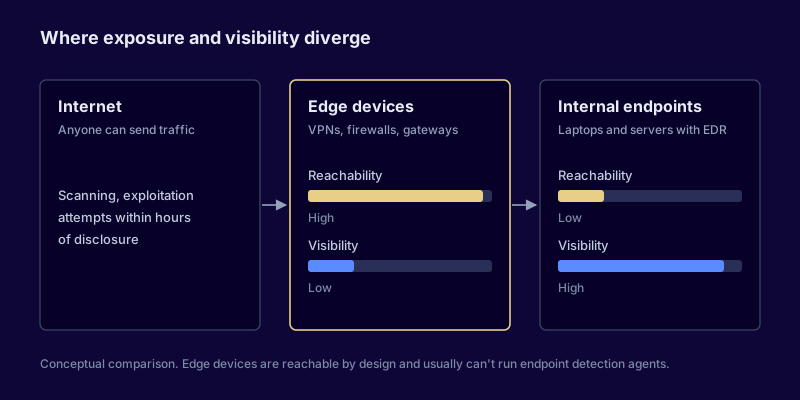
Figure 1. Edge devices combine maximum reachability with minimum visibility, the opposite of the endpoints most detection investment covers.
How conventional programs under-weight the edge
Vulnerability management programs usually start from a scanner’s output, ranked by CVSS score and counted by volume. That model has two blind spots for edge devices.
First, volume dominates attention. A large estate produces tens of thousands of endpoint and server findings each month. A handful of appliance findings, even critical ones, can sit in the same queue and get the same service-level target as a missing browser patch.
Second, many programs measure remediation time from the scan date, while attackers start the clock at disclosure. By the time a scheduled scan picks up a new appliance flaw, exploitation may already be under way.
CISA’s Known Exploited Vulnerabilities (KEV) catalog helps with the second problem, and the 2024 additions are a fair map of what attackers actually used. A recurring theme in those additions is network and security appliances from many different vendors. Treating KEV inclusion as a trigger, rather than one input among many, is the single most useful change most programs can make.
Rebalancing: what we recommend
1. Give edge devices their own lane
Keep a separate inventory of internet-facing infrastructure: gateways, firewalls, load balancers, file transfer appliances, remote access tools and their management interfaces. Track it against vendor advisories directly. Don’t wait for the scanner. The inventory is short enough that a person can own it.
2. Set a remediation clock for the edge
For internet-facing devices with an actively exploited flaw, the target should be measured in hours to days, with a defined emergency change path agreed in advance with infrastructure and the business. If a patch isn’t available, the playbook should cover mitigations: restricting management access, disabling the vulnerable feature, or taking the service offline.
3. Assume compromise when you patch late
Several 2024 advisories explicitly warned that patching alone wouldn’t remove an attacker who already had access. For any device patched after exploitation began, run the vendor’s integrity checks, review configuration for unexpected accounts or changes, and rotate credentials the device held.
4. Get the logs off the box
Forward authentication, configuration change and system logs to a location the device can’t modify. Retention matters. Investigations in 2024 often needed weeks or months of history that devices had already overwritten.
5. Shrink the management surface
Management interfaces shouldn’t be reachable from the internet. That sounds obvious, and the November PAN-OS exploitation targeted exactly those exposed interfaces. Restrict management access to dedicated networks or jump hosts, and verify it from the outside.
What to measure in 2025
Rather than total open vulnerabilities, track these three numbers for edge infrastructure:
| Measure | Why it matters |
|---|---|
| Time from KEV listing or vendor exploitation notice to mitigation | Reflects attacker timelines, not scan schedules |
| Share of edge devices with off-box logging and adequate retention | Determines whether an intrusion can be scoped |
| Count of management interfaces reachable from the internet | Should trend to zero and stay there |
These measures are small enough to report to leadership monthly, and they track the risk that actually played out this year.