
Building a 2026 Security Roadmap Leadership Will Fund
Every January, security leaders take a roadmap to leadership. Some of those roadmaps get funded in full. Many get funded in part, with the highest-value work cut because nobody could explain why it mattered more than the rest. A few get deferred entirely.
The difference is rarely the quality of the security thinking. It’s usually the structure of the argument. This paper sets out a structure that works, drawing on what 2025 taught about where incidents actually started.
Start from the risks the business already recognizes
Leaders fund work that reduces risks they understand. They’re far less likely to fund a list of capabilities.
Compare two ways of presenting the same initiative:
- “Deploy phishing-resistant MFA for privileged accounts.”
- “Last year, attackers in several high-profile incidents got administrator access by calling help desks and having credentials reset. This work makes that approach fail for our most powerful accounts.”
The second version connects the work to a recognizable event, a plausible scenario and a clear result. It also invites the right follow-up question: what else could an attacker do to reach those accounts?
A useful first step is to write down the five to eight scenarios that would most hurt the organization, in business terms. For most enterprises, the 2025 incident record suggests that list should include:
- ransomware that halts operations for weeks
- theft of customer or regulated data through a third party or SaaS integration
- compromise of an internet-facing device leading to broad network access
- fraud or theft through manipulation of an approval process
- loss of a critical vendor or platform for an extended period
Every roadmap item should trace to one or more of these scenarios. Items that don’t trace to any scenario may still be worth doing, but they should be presented separately as maintenance or compliance work.
Use the evidence you already have
Building the case doesn’t need to start with a new assessment. Most organizations already hold more evidence than they use:
- results of previous assessments, audits and penetration tests
- incident and near-miss records from the past two years
- vulnerability and patching metrics, especially for internet-facing systems
- identity data: privileged account counts, MFA coverage, dormant accounts
- vendor inventories and the access each vendor holds
- recovery exercise results, if any
Pull these together before the planning cycle and compare them with the scenarios. The gaps that matter most usually become obvious: a scenario with weak controls, little monitoring and no tested recovery path is a clear priority.
Sequence the work so each step makes the next one easier
Roadmaps often fail in execution because they put advanced work ahead of the foundations it depends on. Detection engineering struggles without reliable logs. Zero trust architecture struggles without an accurate asset and identity inventory. Automation struggles without consistent processes to automate.
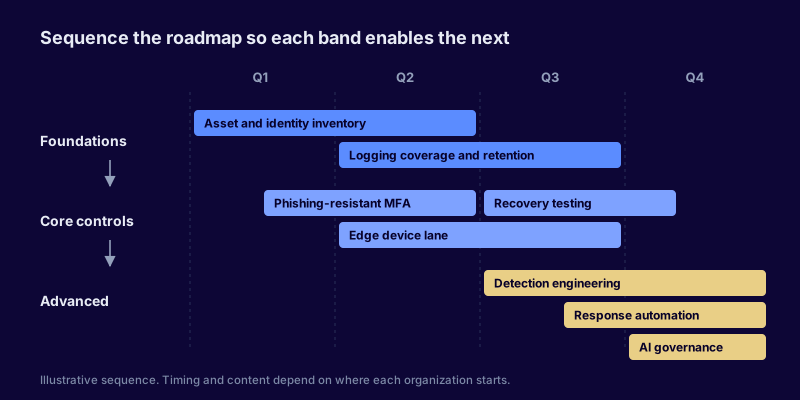
Figure 1. An illustrative sequence. Foundations come first because the later work depends on them.
A practical sequencing approach:
- Foundations that make other work possible: inventories of assets, identities, applications and vendors; logging coverage and retention; basic configuration standards.
- Core controls that address the highest-priority scenarios directly: strong authentication for privileged and remote access, edge device management, isolated backups with tested restoration.
- Advanced capabilities that build on both: detection engineering, response automation, governance for AI systems and agents.
Not every organization starts in the same place, so the sequence will look different for each. The principle is the same: show leadership why the order matters, so that cutting an early item is understood to delay later ones.
Present effort and risk separately
A common mistake is to rank roadmap items by a single combined score. That hides the trade-offs leaders need to see. A high-risk item that takes a year and a low-risk item that takes a week shouldn’t end up side by side because their scores happen to match.
Present each item with:
- the scenarios it addresses and how much it should reduce them, described plainly
- the effort involved: cost, people, duration and disruption
- dependencies: what it needs first, and what it makes possible
This lets leaders make informed choices, for example funding a quick improvement now while a larger project is planned, without losing sight of which risks matter most.
Plan for the year you’ll actually have
A roadmap that assumes every project runs on schedule, every hire is filled and nothing unexpected happens won’t survive the first quarter. Build in:
- capacity for unplanned work. In 2025, emergency responses to edge device and framework vulnerabilities consumed weeks of many teams’ time.
- checkpoints. Quarterly reviews where priorities are revisited based on new incidents, new regulatory requirements and progress to date.
- realistic staffing. If the plan depends on internal teams already at capacity, say so, and show what external help or reprioritization would make it achievable.
Report progress in the same terms
Once the roadmap is funded, report progress against the scenarios as well as against project milestones. “Privileged accounts protected by phishing-resistant authentication rose from 40% to 85%” means more to a board than “MFA project phase two complete”. Use the same scenario list every quarter, so leaders see the organization’s position improve over time.
A one-page format
| Scenario | Current position | Planned work | Effort | Depends on | Q1 | Q2 | Q3 | Q4 |
|---|---|---|---|---|---|---|---|---|
| Ransomware halts operations | Backups not isolated; restoration untested | Isolate backups; quarterly restoration exercise | Medium | Asset inventory | ● | ● | ||
| Data theft through SaaS integration | Integrations not inventoried | Inventory and restrict OAuth grants; monitor exports | Low | — | ● | |||
| Edge device compromise | Slow patching; management exposed | Edge device lane; remove internet-facing management | Low–medium | — | ● | ● |
A table like this, one row per scenario, fits on a slide and answers the questions leaders ask most often: what are we worried about, what are we doing about it, what will it take, and when.
Starting points
If your planning cycle is already under way, three things will strengthen almost any roadmap:
- Rewrite the top five items in terms of the scenarios they address.
- Add a dependency column and check that the sequence holds.
- Separate risk from effort in how you present priorities.
The security work itself may not change at all. How it’s understood, and how much of it gets funded, usually does.